Court System

December 2019

Mechanics of Plea Deals

By |2025-09-26T03:00:37+00:00December 11, 2019|Court System, Criminal Justice, Legal Overviews|

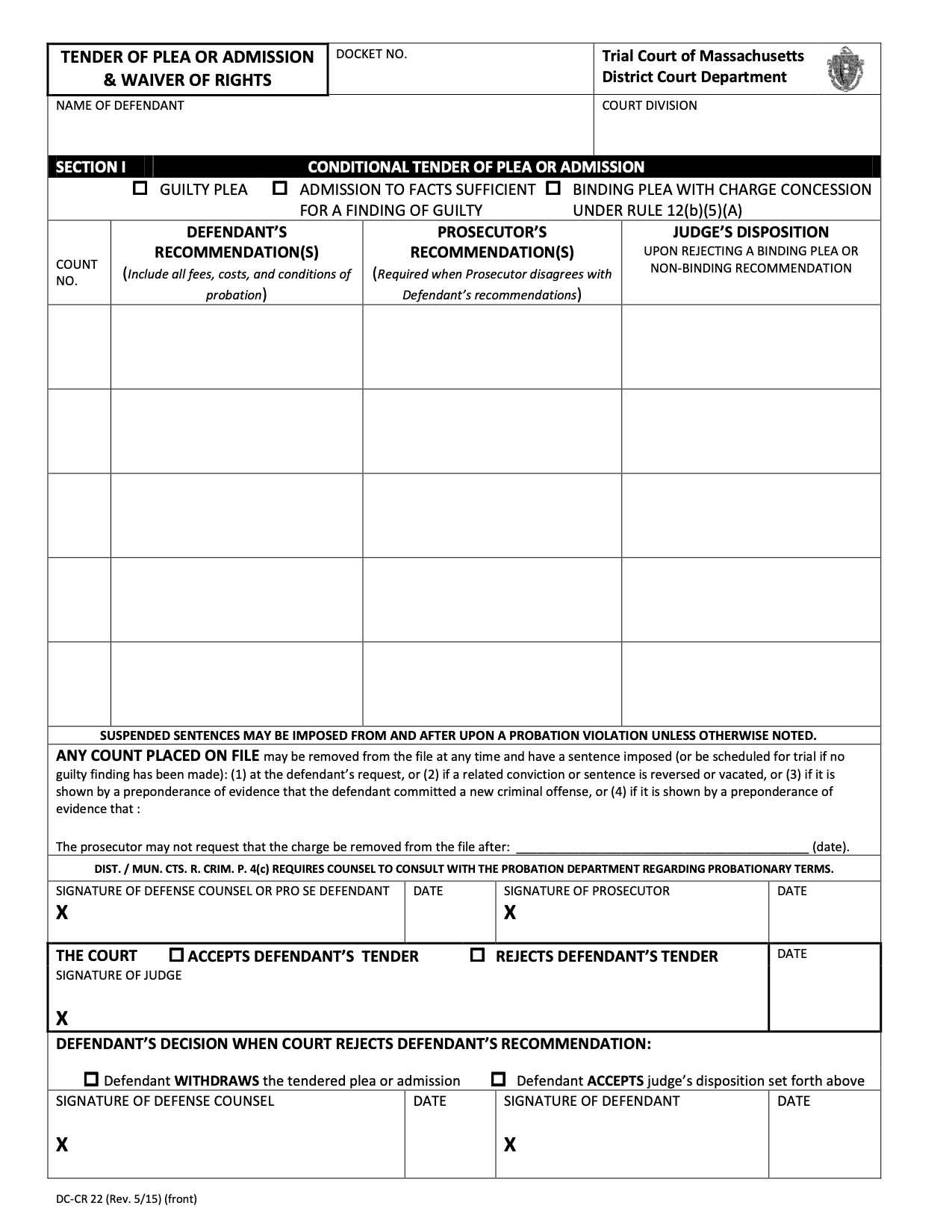
Criminal cases are often resolved through plea deals.  So how exactly do they work?  Well, like most things in the court system, there is a form for it!  Take a look at the attached image, which is the front page of the “Tender of Plea” sheet.  Some lawyers refer to these as “green sheets,” as some courts print these forms on green paper, although many no longer do so. 

The most important part of this form is found in Section I, the “Conditional Tender of Plea or Admission.”  At the top of this section are three options, the first two being the most common, either a “Guilty Plea” or an “Admission to Facts Sufficient for a Finding of Guilty.”  The latter is also known as a “Continuance Without a [Read More…]
November 2019

No Deal!

By |2025-09-26T03:00:38+00:00November 25, 2019|Court System, Criminal Justice|

Clients facing criminal charges are often eager to put things behind them by making a plea deal. That’s because open, or pending, cases can show up when applying for jobs, housing or professional licenses. While it is true that a major part of any criminal defense attorney’s job is structuring favorable plea deals, sometimes it is not in the client’s best interest to do so, at least not prematurely.

Cases in busy District (and Boston Municipal) courts are handled by a group of assistant district attorneys. These ADA’s are given huge caseloads, and must out of necessity prioritize their cases. The result of this is that sometimes things don’t get done by the prosecution, such as contacting and following-up with [Read More…]

May 2019

Tripping Up On Probation

By |2025-09-26T03:00:38+00:00May 13, 2019|Court System, Criminal Justice|

In many instances, those charged with crimes will end up with a sentence of probation as an alternative to doing time. But probation has its pitfalls. If you are on probation and your probation officer believes that you have failed to satisfy a “term or condition” of probation, your probation could be revoked and you could be incarcerated.

Probation violation hearings occur in two parts:

Part 1 is a Probation Detention Hearing, at which the court determines whether there is “probable cause” that a violation has occurred. The probationer and his attorney can be heard. If the judge finds probable cause, he/she must determine whether the probationer should be held in custody pending…

March 2019

911 Calls as Evidence at Trial

By |2025-09-26T03:00:39+00:00March 6, 2019|Constitutional Law, Court System, Criminal Justice, Legal Overviews|

Can a 911 call be entered in evidence at trial? This is a question that I get often from clients, and the answer is “it depends.” At trial, the most powerful testimony is that of someone on the stand, speaking to the jury. Witnesses, oftentimes alleged victims of crimes, are afforded the opportunity to be heard. But sometimes witnesses are unavailable or unwilling to testify. What then?

The Supreme Court and the Massachusetts SJC have all weighed in on whether 911 calls can be admitted absent the caller’s live testimony. The key question in such an analysis is whether the caller was reporting an “ongoing emergency,” or whether the caller was reporting something that had happened earlier.

In [Read More…]

December 2018

Pre-Trial Diversion

By |2025-09-26T03:00:39+00:00December 28, 2018|Court System, Criminal Justice, Legal Overviews|

At arraignment, an entry is created on a defendant’s Board of Probation (BOP) record. This record, sometimes called a “rap sheet,” is an overview of your criminal history and includes juvenile court records, adult court records and restraining orders. Judges have access to all this information and use it when making decisions regarding bail and plea deals.

As you might imagine, less is more; that is, the fewer entries on the BOP, the more likely a case can be resolved in your favor.

That is why the expansion of Pre-Trial Diversion, enabled under the new criminal justice reform laws, is hugely important.

The new laws allow the court to postpone arraignment if certain conditions are met:

1) No convictions for any [Read More…]

Go to Top